Orchestrating work: when AI agents become the players, students must become conductors (and composers).
Every orchestra has three roles: players, composer, conductor. Until recently we trained students to be players. Generative AI is changing which role they need to inhabit.
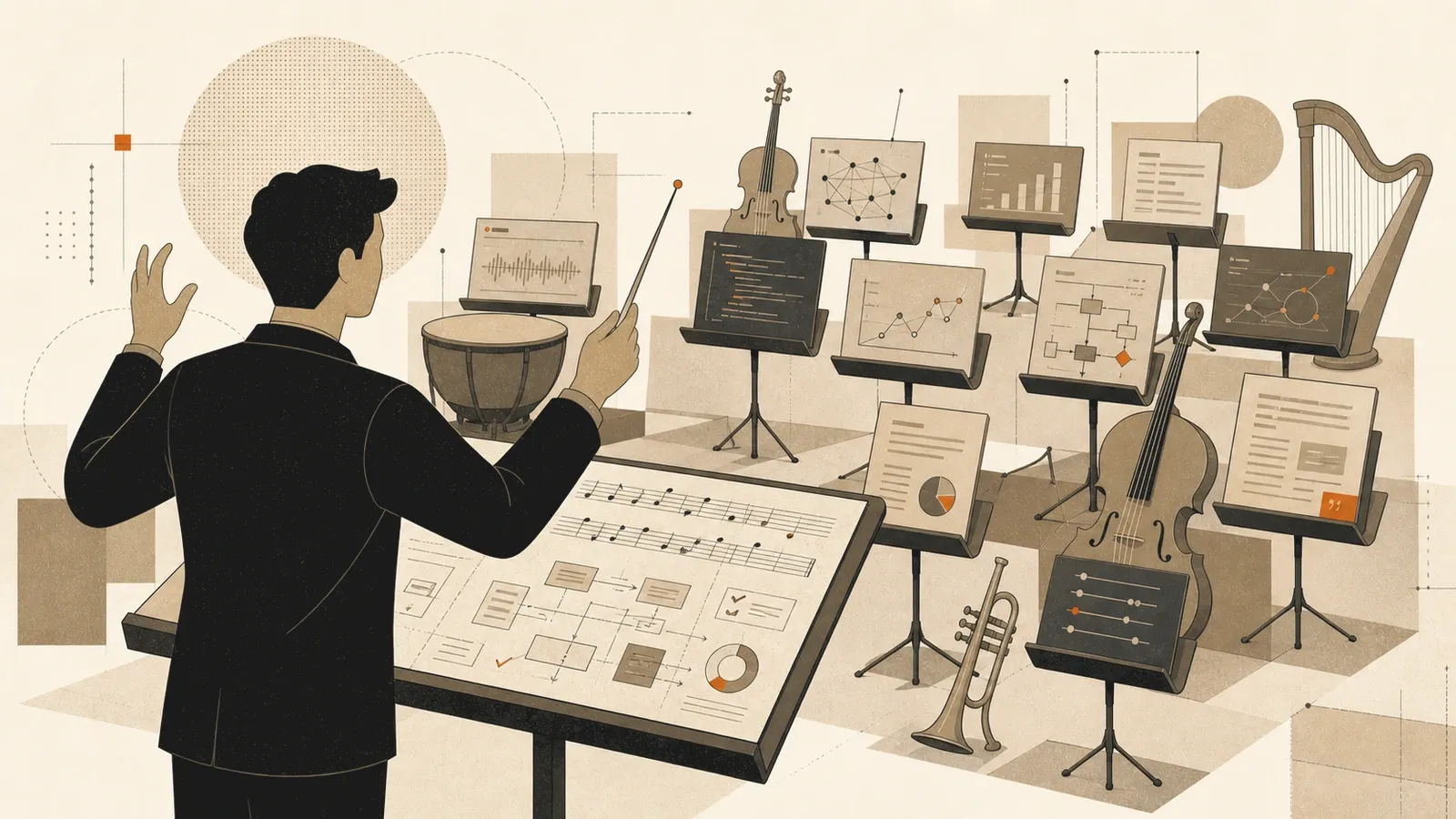
When you sit in a concert hall and the music rises, it feels like a single thing: the orchestra, playing. It is actually three different kinds of work braided into one sound. In front of you are the players, bows moving and breath flowing, turning marks on a page into sound in the room. Somewhere behind the music is the composer, who may have died two centuries ago, and who decided, note by note, what was worth playing in the first place. And on the podium, back turned to you, making no sound at all, stands the conductor, shaping how all of it is heard: how fast, how loud, when a passage should surge and when it should sit back so that something else can come through.
Three different jobs. A great violinist is not automatically a great conductor. A great conductor is rarely a great composer. The work each one does is recognizable to the others, but it is not the same work.
An organization runs on the same three kinds of work. The new graduate arrives as a player, is handed a score (a model to build, a memo to draft, an analysis to run), and judged on how cleanly they execute it. The manager is the conductor, rarely touching an instrument, deciding how the work should be shaped, what to emphasize, what to cut, whether the result is ready to be heard. The executive is the composer, imagining and choosing what the organization should play at all: which markets to enter, which products to create, which problems are worth the orchestra’s time. The traditional career is a slow move through these chairs: from playing, to conducting, to, for a few, composing.
Higher education has been almost exclusively an apprenticeship for that first chair. We train students to read the score (the case, the dataset, the regression output, the legal brief, the lab protocol) and to play the notes (build the model, write the SQL, format the deck, draft the memo, run the assay). Conducting and composing we have mostly left for later: learned on the job, or in the additional training of an MBA, by people who had already proven they could play.
The arrangement was always a little misleading. Within a year or two, most graduates are already conducting. They set down the instrument and find themselves across the table from the people still holding one, asking the questions a conductor asks. Why this analysis and not another? What did we decide to trust about the data? What is this number hiding that the last one revealed? Is this good enough to put in front of the board?
It worked well enough, not because conducting is just advanced playing (it never was; a conductor trains as a conductor), but because having played gave you an ear for the work. The manager directing an analysis had once built one by hand. They could tell good work from bad, and they knew where the danger was. The conductor’s craft still had to be learned on its own. Playing was only the first rung, but you could not skip it.
Generative AI does not remove the bottom rungs of that ladder. It stands on them. The playing still gets done, just not by the person who needs to learn from it. You cannot climb a rung you never step on.
In a classroom this fall, a student who has never written a line of Python can brief a coding agent and ship a working application by the end of a weekend. A student who has not yet learned the seven canonical chart types can ask an AI to produce one and decide whether it tells the truth. A student who has never built a financial model can have an agent build a defensible first version in twenty minutes.
What the student cannot do, yet, is direct the agent toward a deliverable that is actually worth shipping. They cannot judge when the agent’s confident-sounding output is wrong. They cannot tell a board why this analysis answers the right question. They cannot say no to the AI’s first suggestion in pursuit of a better one. They cannot frame what should be built in the first place.
In other words: the player work is now done by agents. What is left to teach is the conductor’s work and the composer’s work. And these are not natural extensions of being a good player. They are different jobs.
What the conductor does
The conductor decides interpretation. In our context: how the analysis should be framed, what counts as good evidence, what should be made visible and what should be left out. The conductor verifies. The conductor knows when the playing was beautiful but wrong, when the model fit was excellent but the data were rotten, when the dashboard is gorgeous but answers a question no one was asking.
You cannot conduct what you cannot hear. Conducting requires enough fluency with the underlying craft to recognize when the playing has gone wrong. Not the ability to play every part yourself: no one is a world-class violinist and harpist and oboist at once. But enough to know good playing from bad in each, and to know what to ask for.
What the composer does
The composer both creates what did not exist and chooses what is worth playing. Composers are the visionaries and, in their way, the entrepreneurs: they hear music that has not been written yet, and they decide which of it the orchestra will perform. In our context, the composer imagines the product nobody asked for, the strategy that redefines the market, the research question that opens a field, and judges which of these is worth committing to. They do not only choose among the options on the table; they put new ones on it.
Composing is less recognized as a skill than conducting, but it is the harder of the two, and the one most easily collapsed into the conductor’s role. The composer is the person who sees that the firm should be building something different entirely, that the work the team has done for six months answers the wrong question, that the real opportunity is one no one in the room has yet named.
What the curriculum has to do
Once you see this, the question for any program preparing people for knowledge work is no longer “should AI be in the curriculum?” or even “should students learn to use AI?” The question becomes: what does the syllabus look like if the player part of the work is done by agents?
In my own corner of the curriculum, I am redesigning four MBA courses and a master’s-level analytics course around exactly that question.
What that looks like varies from course to course, but the move is the same in each. The foundational craft stays on the syllabus (the history of how information systems reshape a business, enough Python to read and debug what an agent writes, the Tableau fluency to catch a chart that lies), but it is no longer what earns the grade. With an agent doing the technical playing, a manager who has never written code can now do the work rather than only read about it: brief an agent to build a working system and verify what it produces, supervise an analysis and defend every decision in it, direct generative AI and judge whether it answered the real question. Work we once taught non-technical students only in concept, because they could never actually perform it, they now perform. In the master’s-level client practicum the whole semester runs on four phases (Plan, Direct, Verify, Deliver), with AI required on the team project and forbidden on individual work, so they feel the difference between conducting and playing for themselves.
None of this is “AI in the syllabus” in the additive sense of a new module bolted onto an existing course. The center of gravity of the whole curriculum moves. The skills we used to spend most of class time building (the technical fluency that lets a person execute a deliverable) become an entry condition. The skills we used to expect students to acquire on the job (the judgment that lets a person direct execution, the vision that lets a person decide what is worth executing) become the curriculum.
The discomfort
This is uncomfortable. There is something poignant about telling students they will never need to do the thing we have been training them to do. There is also a real risk that we accidentally produce a generation of graduates who cannot tell when the music is wrong, because they never learned to play it.
The bet I am making, in the curriculum redesign, is that the right response is not nostalgia for the player era but a deliberate cultivation of the two jobs AI cannot do for us. Conducting requires taste, verification, and the courage to overrule a confident-sounding agent. Composing requires a theory of what the work is for and what problems are worth solving. Neither is acquired by passively watching AI work.
You acquire them by composing and conducting, badly at first, in a classroom that asks you to do exactly that.